


Eva Henneberry
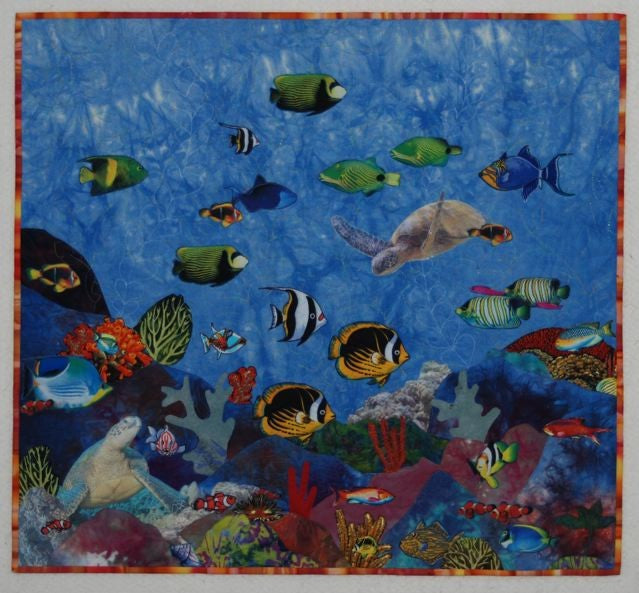
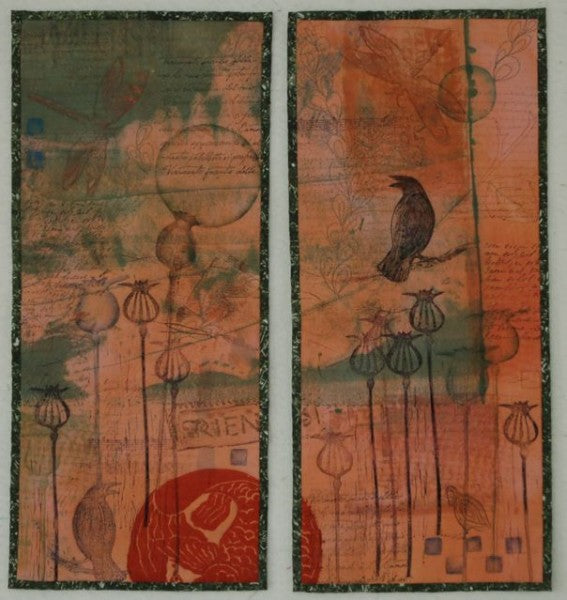
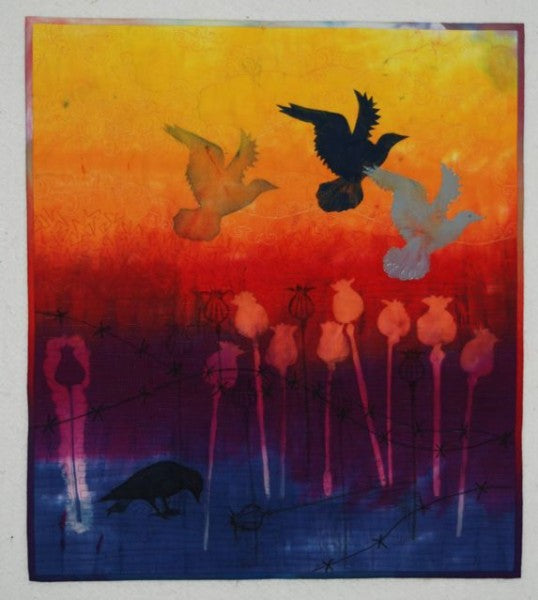
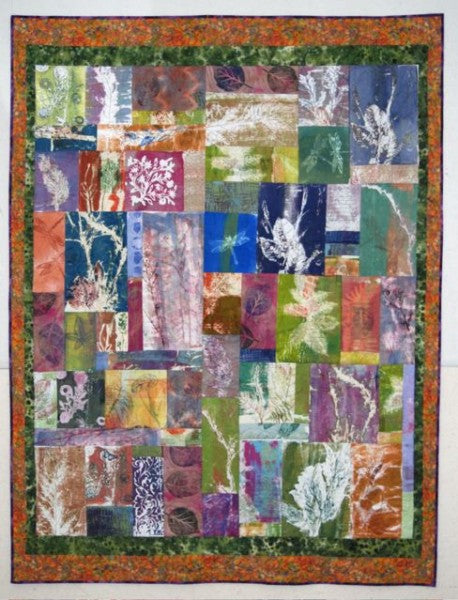
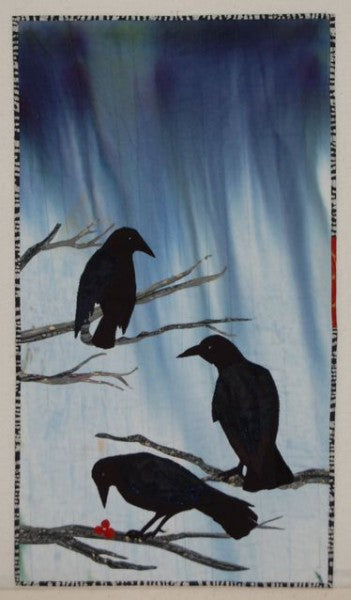
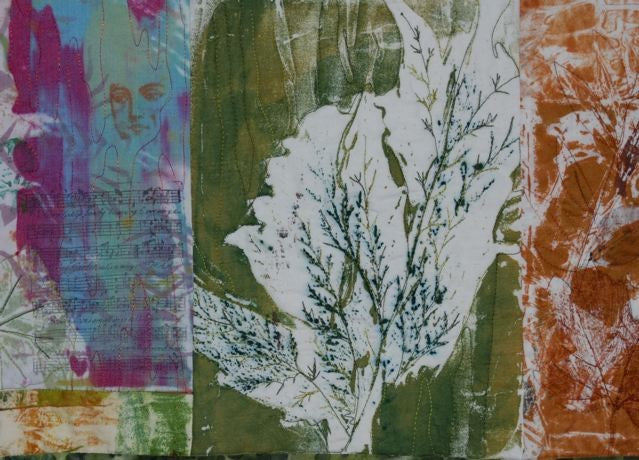
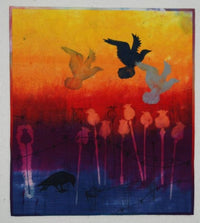
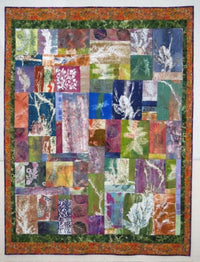
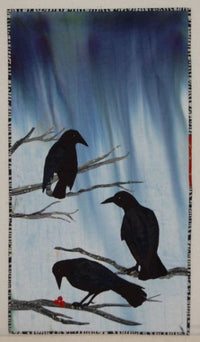
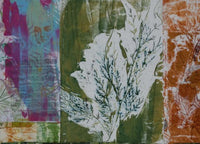
I have been a quilter for many years. Like many, I started out with more or less traditional designs, but in the mid 1990s, I started to veer off into my own thing. I am self-taught, but I had a lot of exposure to art growing up. I had done a variety of techniques from painting and drawing to clay work, and then some sewing. Now I dye much of my fabric, which I then discharge, overdye, print, and stencil on for many of my quilts. I started using Procion dyes about ten years ago and still love them. I also use the stamp pads and ink, as well as the quick stamp to make designs for a given project in just minutes!
I am not afraid to "augment" my work with fabric crayons and markers. On my quilts, I mostly use raw edge applique and collage. My most recent technique is discharging, which has been a lot of fun. I love looking through the Dharma catalogue, drooling over all the many new tools available - I hope to try many more of them!
Eva Henneberry
www.evahenneberry.com
Received January 25, 2010 - In Memory of Eva Henneberry
Dr. Eva Jalkotzy Henneberry, family practitioner, internationally shown art-quilter, and passionate advocate for peace, social causes, and the environment, died in Chico, Calif., Jan. 12. She was 65.
Born and raised in Vienna, Austria, Eva was the daughter of Herta and Alois Jalkotzy. From her mother, who was trained as a gold and silversmith, she acquired her love of art. And from her father, who was active in politics and dedicated to leaving the world a better place, she gained a commitment to social advocacy. Her younger sister Jalka (no last name) said that, as a child, Eva was a calm, careful, kind, friendly, well-behaved, popular girl who avoided confrontations. But she also had great emotional strength, which Jalka believes allowed her to "harmonize in many directions, even in opposing ones."
Meg Chapman, who met Eva at a quilting workshop in 2002, described Eva as a woman who was honest with others and herself, courageous, compassionate, charitable and fun to be with — a "mentor on how to live life."
"She lived her life the best that I ever saw a person do it," Chapman said. Eva came to the United States in 1962 after being awarded an American Field Service scholarship and spent a year in Newport Beach, Calif., with a host family she described as "wonderful and supportive." Once back home in Vienna, she set her sights on returning to the United States. When she was accepted at Columbia University in New York City, she was able to realize her dream of moving back to the States. While on the East Coast, she made frequent trips to Vienna to visit family and friends.
After graduating from Columbia with a B.S. in physical therapy in 1965, she worked as a physiotherapist in a unit for post-polio patients hooked up to breathing machines in the chronic disease hospital on Welfare Island. Her friend, Miriam Hirschfeld, an official with World Health Organization, said that it was "hard and heart-wrenching work" but that Eva loved it and stuck with it. "Eva lived an incredibly genuine life, following what she felt was right for herself and for others," Miriam said.
In 1969, Eva moved to the West Coast and became part of the "back to the land" movement. She bought some land near Garberville, where she built a cabin and lived "off the grid." In 1972, her son Orfeo was born. Orfeo's father, Narcissus Quagliata, now a well-known stained-glass artist, was a starving artist at the time. With the goal of improving her family's financial situation, Eva returned to San Francisco when Orfeo was still a baby and began taking pre-med courses at San Francisco State University. During that part of her life, Miriam said that Eva not only achieved "the unbelievable," by earning all A's in pre-med but she was also accepted to the University of California San Francisco medical school. And while other graduates went in search of lucrative practices, Eva decided on "genuine family medicine." During her residency at the U.S. Public Health Hospital in San Francisco, she met Bill Henneberry, a professional seaman, who was to become her husband.
"I have always believed she made me want to be a better person," Bill said, who attributes his decision go to law school and seek political office in his trade union to Eva's steadfast belief in him and her ability to inspire him. In 1983, the family, which included Bill's son Scanlon, moved to Red Bluff, Calif., when Eva was offered the position of medical director of Tehama County Health Center. In 1986, their son Julian was born, and 3 years later, the family moved to Chico, Calif. Eva's love of her family had no bounds, often sharing with friends her pride in her sons and her amazement at their different personalities and philosophies of life.
Although Eva began making traditional quilts during her first semester in medical school when she created her first "art quilt" in 1997 after her mother died. The water color quilt, which she titled "Mormor," celebrated her mother's life. With that quilt, art became a central focus of her life, and she spent all of her free time in her studio creating beautiful art quilts, most of them with a social message.
In a statement on her website, Eva said that while she loves and enjoys creating aesthetically pleasing pieces, she feels "truly most balanced when they also make a statement about the world I wish to help create. It is meaningful to me that quilt-making is a woman's art and heritage and that I am but one link in a tradition of women expressing their opinions and feelings in cloth, needle and thread."
In 2008, Eva and Bill moved to Ferndale, Calif., where she continued quilting. She participated in the Humboldt County Fair's quilt show and served as president of the Ferndale Community Art Gallery. She was also elected to the board of the Riverside Community Services District. In August and September, she was the "artist of the month" at the Ferndale Community Art Galley. Through the years, Eva took part in many group exhibitions in places that included England, Lithuania, and Austria. She also had solo exhibitions in Austria, La Conner, Washington, Garberville, Chico, and Atlanta, Georgia. Her quilts also won awards — some of them first-place awards — in shows in California.
Last year, the U.S. ambassador in Ankara, Turkey, selected three of her pieces to display at the embassy. She was thrilled to also receive an invitation to come and be the ambassador's guest at the embassy so she could see how her quilts, one of them titled "Global Warming," had been hung. In October, she visited her sister in Vienna, followed by a trip to Turkey and a quilting workshop in Klagenfurt, Austria. This past December, after she had gone through surgery for brain cancer, her friends joined together to hang quilts for her show at the Upper Crust store in Chico. Besides her husband and her two sons, Orfeo Quagliata and Julian Henneberry, and step-son, Scanlon Henneberry; and her sister Jalka, Eva is survived by sisters Brita Karabaczek and Inge Jalkotzy and several nieces and nephews.
Eva's website will be maintained, at her request. "Eva will "Be" with us through her body of work," he said. "I am uniquely positioned to tell everyone how important that was to her." Memories of Eva are suffused with love. "We are not without Eva, since love cannot be separated," Jalka said.


Become a Featured Artist
We thought it would be a neat idea to showcase the work of artists and businesses who are using Dharma products, so we've been asking customers to send in photos and info so we can share it with you. If you use our products and would like to be included.


