


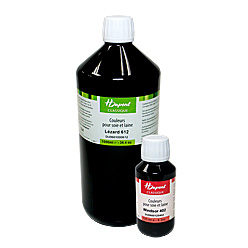


Dupont Silk Dyes - French Silk Dyes
USE FOR: Silk Painting - Serti silk technique, water color, alcohol and salt effects, Tie-dye & Batik on silk, silkscreening (thickened)
USE ON: Silk and wool
Dupont Silk Dyes are very popular throughout the world and are used by a lot of professional silk artists because of the wide range and intensity of colors offered, the permanence of the dye and the superior way they lend themselves to salt and watercolor techniques. These are very concentrated dyes which should always be diluted before use. Steam to set.
Stock # Details 1-9 10+
#DUP60 50 ml. (1.7 oz.) $8.45 $7.75
#DUP250 250 ml. (8 oz.) $18.95 $17.45
#DUPLT 1000 ml. (32 oz.) $43.25 $38.37
All prices calculated in US$
Available Colors
ColorNameSizesQuant
108 Bleu Roy (Primary)
196 Grenat
275 Gris Perle
314 Limoges (Primary)
317 Bleu Indien
318 Windsor
322 Myrthe
324 Lezard
327 Amaranthe
330 Helianthe (Primary)
331 Helianthe
333 Helianthe
335 Violine
342 Loutre
346 Paon
351 Rubis
353 Fuschia
359 Maroc
366 Coquelicot
367 Coquelicot
372 Antilope
374 Trefle
Dyes - 50 ml. (1.7 oz.) - Sorry, this item is temporarily sold out.
376 Fougere
381 Sultan
383 Mme Meilland
386 Orchidee
389 Orchidee
390 Cerisette (Primary)
393 Canari (Primary)
397 Vert Nacre
402 Amande
406 Madrilene
409 Emeraude
410 Negrillon
413 Cigare
Dyes - 250 ml. (8 oz.) - Sorry, this item is temporarily sold out.
420 Ardoisiere
425 Linaire des Alpes
Dyes - 250 ml. (8 oz.) - Sorry, this item is temporarily sold out.
426 Cuivre
430 Taupe
435 Chamois
448 Soleil
451 Olive
474 Camelia (Primary)
482 Aurore
493 Lierre
502 Grenade
507 Giroflee
511 Marine
518 Ara
521 Outremer
524 Castor
526 Bleuet
Dyes - 50 ml. (1.7 oz.) - Sorry, this item is temporarily sold out.
530 Lumiere
538 Condor
550 Amiral
551 Vieux Bleu
554 Mais
565 Printemps
566 Pamplemousse
570 Souris
576 Delphinius
584 Caramel
590 Angelique
603 Carmin
611 Artichaut
614 Bordeaux
615 Brique
620 Vert Feuillage
626 Citron
700 Noir (True Black)
701 Absinthe
800 Targa
801 Muira
802 Bronze
803 Rose Tyrien
804 Vert Anglais
805 Saumon
806 Beige Sable
807 Menthol
808 Platine
809 Vert Sapin
810 Bleu Nuit
811 Cedre
2019 Noir Concentre
About:  Security - Shipping - Returns
Dupont Silk Dyes - Thinner/Dilutant
noimage Use this product to thin and dilute Dupont Silk Dyes. Mix 1 to 2 tablespoons with one quart of water. Shake it well and then keep on hand and use it as needed.
Stock# Description Quantity Price
#DUPT60 60 ml. (2 oz.) $2.95
In Stock Now.
#DUPT250 250 ml. (8 oz.) $11.50
In Stock Now.
#DUPTLT 1000 ml. (32 oz.) $35.95
In Stock Now.

Product Description
Dupont Silk Dyes are very popular throughout the world and are used by a lot of professional silk artists. They are considered by some to be the best silk dyes in the world. Others think Tinfix or another brand are the best. Different strokes, different folks.

Dupont dyes have been made by Mr. Dupont in France for 60 years (he must be getting very tired) and are the dye of choice for many because of the wide range and intensity of colors offered, the permanence of the dye and the superior way they lend themselves to salt and watercolor techniques.

These are very concentrated dyes which should always be diluted before use. For silk, dilute with the dilutant above for best results, or if you don't care if it is streaky, an alcohol/water mixture. For wool, Dupont recommends using at least 50% Industrial Alcohol. Depending on the shade desired, dilute from 10% to as much as 50%. When you realize how concentrated they are, they become more reasonable in price.

Dupont dyes are manufactured without Aniline but do contain Alcohol for a preservative. Dupont dyes must be set by steaming (1-4 hours, depending on the type of fabric and thickness of the roll), and once set, can be washed, drycleaned and are light resistant.

Colors
The Dupont color chart shows 120 colors. Many are too close to tell apart. We stock the first 90 colors (actually, some have been discontinued, so we actually have 81 now). We have a color chart which you can have free for the asking (when we can get them from France) or you can see it in our catalog. In addition, all of the colors can be mixed to produce your own range of unique colors.
Primaries Colors:
Yellow = 393 or 330
Reds = 474 and 390
Blue = 108 or 314
Black = 700

OTHER STUFF
Concentrated Dye Thinner/Dilutant: For the most even results, use this product mixed with water to thin Dupont Dyes and achieve a variety of color gradients.


Silk Painting - Techniques

The Serti (closing or fence) technique is the silk painting technique where designs are formed with gutta or water-based resists, which are applied to white silk that has been pre-washed, dried and stretched (on a stretcher). Once the gutta or water-based resist has dried, it acts as a barrier for the dye or paint—keeping the color within the outlined areas of the design and allowing you to achieve sharply defined borders. (Without this barrier, the dye or paint would flow into more of an abstract, undefined pattern.) After the dye or paint has been properly set, the clear gutta or resist is removed and a defining line the color of the original fabric remains. Colored guttas and resists are also available that are meant to remain in the fabric.

Detailed patterns without resists can be achieved by instead priming the prewashed and stretched silk with a stop-flow primer which is left to dry before painting on the dyes or paints. The color will stay where you put it, rather than migrating. Allows for freehand painting without gutta or water-soluble resists. Think of stop-flow primers as starch-like sizing to prepare the canvas with. They wash out in the end.

Watercolor-like effects can be achieved by applying dye or paint to silk that has been pre-washed and put on stretcher bars whether or not you are using resists (but not if you are using stop-flow). Dyes or paints are applied to the silk with a paint brush, mist sprayer, eye dropper, or other tools to achieve abstract effects. Spraying the silk lightly with water before adding color increases the flow of the dye or paint. Sprinkling silk salt on the piece when still wet, and leaving till completely dry before brushing off the salt, produces interesting textural effects. Applying alcohol to dye-painted silk also creates beautiful effects.

WHAT YOU NEED:
- Silk Paints or Dyes
- Paint Brushes
- Gutta or Water-Soluble Resist
- Applicator Bottle for the resist
- Some kind of Stretcher Frame
- A white silk item to paint on

HOW IT'S DONE:
Step 1: Prewashing your silk
Step 2: Preparing your design
Step 3: Making a Stretcher Frame
Step 4: Stretching your silk
Step 5: Applying gutta or resist
Step 6: Applying dyes or paints
Step 7: Setting/Fixing the color
Step 8: Removing clear gutta or clear water-based resist

Step 1: Prewashing your silk
Pre-wash your silk by hand or in the washing machine on a gentle cycle with warm water and Synthrapol. Rinse, dry and when still slightly damp, press with an iron, set to the silk setting.

Step 2: Preparing your design
With a pencil or vanishing marker, lightly draw your design onto the silk. The Serti Technique lends itself well to designs with enclosed areas where the color will be contained within the resist lines.

Step 3: Making a Stretching Frame
You will need a frame to stretch your silk and suspend it off the table. There are a variety of types of frames you can use, depending on the size of the piece you are painting and the materials that are available to you. Artist's canvas stretcher bars work very well. They are sold at most art supply stores in different lengths, in pairs. Old wooden picture frames also work well or you could build your own frame with wood. The wood that you use needs to be soft enough to allow push pins or 3-pronged tacks to be pushed into it. In a pinch, you could also cut out a frame from a cardboard box.

If you are painting a piece that has already-finished edges (such as a scarf), you will need to make sure that the inside measurements of the frame, are at least 2-3 inches larger (on each side) than the silk piece you will be painting so that the edges of the silk will not make contact with the stretcher bars (which would leave unwanted paint marks on the silk). You can create a 'trampoline' effect with rubber bands and safety pins or silk clips (see below).

Step 4: Stretching your silk
Stretch your silk onto your frame with stainless steel push pins or silk thumb tacks every 4-6 inches along each side. Another method is to use rubber bands and safety pins, silk clips, or Chinese Suspension Hooks: attach small safety pins, clips, or hooks connected to rubber bands to the edges of the silk, every 4–6 inches; the rubber band then goes around a push pin which pins into your frame). If need be, you can link rubber bands together for extended lengths. The advantage of the rubber bands method mentioned above is that the elasticity of the rubber bands will maintain the tension of the silk for you.


The goal when stretching your silk is to create just the right amount of tension so that the silk remains taut while you are painting but not so tight that it tears. Your piece may have a tendency to sag a bit once it becomes wet with dye or paint; you may need to adjust the pinning as you are painting.

Your frame also needs to be suspended a few inches above your table so that the silk does not have anything touching it; you can do this by placing upside down plastic cups or wood blocks underneath each corner of your frame.

Step 5: Applying your gutta or resist
(see discussion of Guttas vs. Water-soluble Resists to decide which to use)

Using even pressure and a steady hand while holding the applicator bottle vertically with the tip touching the silk, draw on your resist lines. Be sure that there are no breaks or gaps in the line (or dye or paint will escape!). Check the back side of your piece to make sure the resist has penetrated all the way through. If it hasn't, you will need to apply resist to the back side as well. (This is sometimes necessary when working on silks heavier than 12 mm. Let the resist dry (you can speed up the drying time with a blow dryer, or heat gun) before painting.


Step 6: Applying your dyes or paints
(see discussion of dyes vs. paints to decide which to use)

Dip your brush into the color and apply the dye or paint sparingly to the center of an outlined area by touching the brush to the silk. Let the paint move to the resist line – do not apply the paint too close to the resist (if water-based resist becomes too saturated the line may begin to dissolve!) If there is a gap in your resist line that you didn't notice and the dye or paint starts escaping, you can stop the movement by drying it quickly with a hair dryer and then patch up the line with gutta or resist and let dry before resuming. When painting large areas (e.g., background), work quickly, applying wet to wet to avoid unwanted lines.


Step 7: Setting the color
When you have finished applying the dye or paint to the silk yardage or scarf, it's not permanent until you "set" or "fix" the color so that in the future you can wash or dry clean the piece without all the color washing out.

The method of "setting" or "fixing" the color depends on the chemistry of the dye or paint you are using. Before purchasing any dye or paint, you should read the directions thoroughly to determine if the required procedure fits your project and situation.

Setting paints with heat (Dye-na-Flow, Seta-Silk, Silkcolor by Sennelier, Arty's Heat-Set)
Allow to dry 24 hours before heat-setting the paints with an iron, 2-3 minutes on each area of your piece, face down on your ironing board with a press cloth between the silk and your iron. You may also want a protective cloth on the ironing board as well. Work in small areas at a time, moving in a small circular motion so as not to burn the silk, but also so that each section maintains the heat for a long enough duration to actually set the paint.


Setting dyes with steam (Sennelier Tinfix Design, Pebeo Silk (Pebeo Soie), Jacquard Silk Colors (green label), Dupont French Dyes, Procion Liquid H)
Of the two methods for setting silk dyes, the steaming method produces the most brilliant colors. Some people don't want to go this route, but those who do are usually very happy with the results. Read detailed steaming instructions.

Setting dyes with chemical fixative (Tinfix fixative for Tinfix Design, Jacquard Dyeset for Jacquard Silk Colors)
If you don't want to go the steaming route, Tinfix and Jacquard have liquid fixatives for their respective dyes. They can be painted on top of the dyes, or the project can be submerged. The colors will not be as brilliant and they may not be as colorfast as they would if set by steaming. Follow the manufacturer's directions for using the chemical fixatives.

Step 8: Removing clear gutta or clear water-based resist
Once the dye or paint has been properly fixed, it's time to remove the gutta or resist. Clear gutta is removed by dry cleaning. Clear water-based resist is removed by rinsing in warm water. It comes out easily when used with iron-set paints, but some brands can be very difficult, if not impossible, to remove after steam-setting dyes. Once the resist is removed, hang dry, then iron lightly while still slightly damp. See our gutta vs. resist page for more details.

If colored guttas have been used, do not dry clean (the color will come out with the gutta)! They are meant to leave on the silk. There will be some "hand" or "feel" on the silk. Some people prefer to use the colored guttas on wall hanging pieces only, rather than on wearable art.

If colored water-based resists have been used, follow the manufacturer's instructions for heat-setting with an iron before painting on the color. See our gutta vs. resist page for details. The colored resists are meant to stay on the fabric. There wil be a "feel" on the fabric.


Steamsetting Silk Dyes

When you have finished applying the dye to the silk yardage or scarf - it's not permanent until you do something else. You have to "set" or"'fix" the color so you can wash or dry clean the piece without all the color washing out.

The method of "setting" or "fixing" the color depends on the chemistry of the dye you are using. Before purchasing any dye you should read the directions thoroughly to determine if the required proceedure fits your project and situation (time or space available, inclinations i.e. lifestyle).

DYES AND METHODS OF FIXATION

Steam fixation is essential for the last group of dyes and preferred for many others. They need to be steamed to achieve adequate color intensity and washability. The high temperature heat and pressure produced by steaming bonds dye and silk molecules together.

Best results are achieved using a professional home steamer. Dharma carries two types: the upright electric self-contained steamer and the stove top steamer. Smaller pieces can, however, be steamed successfully on the stove much like one steams vegetables.

PREPARING THE FABRIC FOR STEAMING

When steaming it is important that the fabric does not touch itself at any point. If it does, the dye will transfer from one place to another and cause smearing. Also, water from the steaming process can never be allowed to come into contact with dyed silk. This will create spots and smears and designs you may not desire. To prevent these unwanted effects the fabric must be wrapped or rolled in paper and protected from itself and condensation from the steamer.

Rolling the fabric for the electric steamer or the stove top steamer.

The silk should be rolled between sheets of newsprint or similarly absorbent material - the paper or material you use must be porous enough to allow the steam to penetrate. If you use newspaper, the ink must be completely dry, at least six weeks old.

Roll a few layers of paper onto the pole you are using. Then begin rolling the fabric onto the poll between the layers of paper while keeping it smooth to prevent wrinkles from developing. The paper should extend at least two inches beyond the silk at each end. The length of the paper you use is not important as it can be overlapped. You can roll one piece of fabric or many scarves. Continue rolling until all the fabric is on the roll. Finish by wrapping an extra two layers of paper around the fabric and secure the roll with tape. Place the roll in the steamer and you are ready to start.

Steaming Time

The length of time required to set the dyes depends on the type of dyes and the amount of fabric on the roll. Generally, steam time will range from 1 hour (after the water is boiling) to 3 hours. The larger the roll of fabric, the more time necessary, as the steam must penetrate to the center of the roll. Check the directions of the dye you are using for the correct/ appropriate steaming time and then adjust for the amount of fabric being steamed- the more fabric, the longer the time.


Dupont FAQ
Dupont FAQ

Question:

Can I use different silk dyes or paints in the same piece?

Answer:

Yes you can if they are fixed in a like manner. For example you can use Dupont, Tinfix Design, Jacquard and Pebeo Silk in the same piece because they are all steam set. Just as you can use the silk paints such as Setasilk, Dye-na-Flow or Silkcolor in the same piece since they are all fixed by ironing. However, do not use dyes and paints together in the same piece since they are not compatible when fixing (unless you steam the dye first, then paint and iron fix the paint.)

Question:

Do I need to use the dye-thinner/dilutant for the Dupont dyes?

Answer:

The dilutants for the silk dyes will allow you to thin the dyes and aids in the uniform spreading and merging of the dyes, avoiding hard lines and watermarks. If you just want to dilute the color and want a streaky appearance, just use water. An alternative is the use of alcohol(Isopropyl rubbing) and distilled water in a 50/50 proportion. A drawback to the alcohol dilutant is the odor of the alcohol and good ventilation is needed.

Product Reviews
Average Rating:  4.87 (15 reviews)
Product Rating:
Reviewed: Wed Apr 2 13:50:21 2008
Luminous colors, great dye for textural techniques like salt or alcohol. Love it!!
Was this review helpful to you? 7 of 7 users found this review helpful.
Product Rating:
Reviewed: Thu Mar 20 20:59:56 2008
Rich colors
Was this review helpful to you? 5 of 5 users found this review helpful.
Product Rating:
Reviewed: Fri Feb 15 07:56:02 2008
The dyes I have bought in the last two years are less fluid than the old ones.Often they have a built up of oily scum on top. The range of colors seems very extensive but even with different titles the colors are very similar. Ex.Blu/outremer 521 is almost identical to Limoges.---Red Carmin and Rubis, same impression
A last comment: in many cases the color labels on the bottles are very similar, it is hard to really choose the right color.I am still exclusively using your dyes, so I hope you continue to improve your product.
Thanks Graziella Malagoni
Was this review helpful to you? 5 of 5 users found this review helpful.
Product Rating:
Reviewed: Wed Mar 26 19:09:39 2008
These are the best I've used... Outstanding colors and predictable results.
Was this review helpful to you? 4 of 4 users found this review helpful.
Product Rating:
Reviewed: Wed Jan 28 08:57:33 2009
Very nice colors, I like that they are right out of the bottle and you can add a little water for great colors.
Was this review helpful to you? 1 of 1 users found this review helpful.
Product Rating:
Reviewed: Sat Jun 27 14:03:30 2009
Love this product, I wish I could get Magenta and Cyan!
Was this review helpful to you? 0 of 0 users found this review helpful.
Product Rating:
Reviewed: Fri Jun 19 11:32:15 2009
Was this review helpful to you? 0 of 0 users found this review helpful.
Product Rating:
Reviewed: Fri Jun 19 11:31:33 2009
Was this review helpful to you? 0 of 0 users found this review helpful.
Product Rating:
Reviewed: Thu May 28 07:32:14 2009
Was this review helpful to you? 0 of 0 users found this review helpful.
Product Rating:
Reviewed: Sun May 10 11:37:48 2009
Was this review helpful to you? 0 of 0 users found this review helpful.
Product Rating:
Reviewed: Sat May 2 11:54:23 2009
Colors are amazing...leaves the silk soft, supple and colorful...Love it...
Was this review helpful to you? 0 of 0 users found this review helpful.
Product Rating:
Reviewed: Tue Feb 10 08:42:46 2009
Was this review helpful to you? 0 of 0 users found this review helpful.
Product Rating:
Reviewed: Fri Apr 17 05:02:58 2009
excellent :) thank you!
Was this review helpful to you? 0 of 0 users found this review helpful.
Product Rating:
Reviewed: Tue Jan 27 16:41:52 2009
Was this review helpful to you? 0 of 0 users found this review helpful.
Product Rating:
Reviewed: Tue Jan 27 18:37:14 2009
see below
Was this review helpful to you? 0 of 0 users found this review helpful.

Home | Gift Certificates | Order From Catalog | Request a Catalog | Contact Us
Join Our Mailing List | Customer Service | Track an Order | My Orders | Email This Page
If you'd rather speak with a human, please call toll-free from anywhere in the U.S. or Canada 8am to 5pm PST
Phone: 800-542-5227
Copyright © 2009 Dharma Trading Co. All Rights Reserved.